Working in digital infrastructure in 2026 feels a lot like the 3rd hour of a heated game of monopoly.
The board is littered with bricks. Building has become hard and expensive. Every turn comes with a sense that you may be getting screwed. It seems that every square you land on is someone else’s toll booth. And sometimes you forget why you’re even playing this godforsaken game to begin with.
In real life, there are more questions than just the existential. The central question, however, is whether we are in a bubble, and how likely it is that future AI revenue will pay back the large costs being sunk into infrastructure today.
Regardless of your stance on this AI CapEx debate, everyone can agree that even if AI research plateaued overnight, the latent value of agents has not yet been reached in production. Useful coding agent tasks that should take 3 seconds still take 3 hours…there are more data formats to collect and post-train on.
Leaving aside a rigorous analysis of the future returns to capital, the strong belief that ‘we are not there yet’ is what is driving the full-scale industrialization of compute infrastructure.
It continues to stun and craze; the zeitgeist captured by large IPOs, acquisitions, circular financing, and startups closing 11 figure deals. It’s not often that the term the ‘Wild Wild West’ is used to describe a multi-trillion dollar market arena.

The Ecosystem Matures
Wall Street, the main judge of all the action, for many years was bifurcated between those viewing this as a true generational shift and others bracing for a correction. The complexity of the supply chain made both cases easy to argue.
More recently though, conversations with investors indicate that there is much more clarity and consistency. Financial institutions are converging on assumptions and underwriting risk with similar models of the world. Investors are settling into familiar patterns as a result.
It’s also a lot harder for companies to bullshit (than in software, for example) since physical infrastructure is more easily and systematically monitored by creditors, investors, research teams and satellite imagery. It’s still the ‘Wild Wild West’.... but at least everyone agrees it’s wild.
The Remaining Players

The story has been so wide reaching in part because of the number of businesses touching compute infrastructure.
Ultimately, Nvidia and the hyperscalers have been the dominant authors of the story so far. But, everything is interconnected; from lithography fabricators to PCIe switch vendors and cooling vendors, introducing new constraints and stretching companies in new ways:
NVIDIA is maintaining a balancing act calibrating supply of chips and pricing to enable continued AI scaling without over-saturating the market. Margins act as a control mechanism; high enough to orchestrate chip allocation, but not so high to suppress demand. Undershooting capacity would leak market share to competitors. Meanwhile, competition from hyperscalers is ramping up; their focus is on handling competition from hyperscalers, primarily Google’s TPUs this year.
Hyperscalers have become the primary risk absorbers in infrastructure, paid to bridge risk between counterparties and make markets (facilitating more than 50% of deal activity in the past 12 months). Sitting in the crux of the compute market, they are bridging the gap between volatile compute demand, fairly rigid capital markets while supporting model improvements. As an absorber of most AI compute demand, they have internal mandates to accelerate every part of the stack, including chip production, power and data center development.
Foundries like TSMC can’t afford to have idle fabs if chip demand slows. So, instead of overbuilding to meet speculative demand, foundries maintain a slower development cadence to balance this risk. Given few foundries can manufacture the types of wafers necessary for frontier chip development, TSMC’s determined manufacturing rate often sets the pace of the rest of the industry.
Memory manufacturers like Samsung, SK Hynix are the supply side of a massive memory shortage. The shortage has stretched RAM, SSD, and HDD procurement cycles. But the fastest-moving and largest players with a deep understanding of this tightly interwoven market are able to strategize effectively: According to insiders, OpenAI booked lots of future memory supply via a wafer acquisition several months ago, before this shortage became obvious.
Data center developers (e.g. CyrusOne, Vantage) take low residual risk by sourcing customers for long term leases, leaving the demand risk entirely on the cloud provider. The financing is getting complex - lots of it is moving off balance sheet to decrease direct credit risk, where large “AI factory” developments are backed by cloud and hyperscaler backstops. Legacy players have little advantage in this market. Not only are large AI factory builds very different from legacy, but also new build plans can also be obsolete by the time construction actually starts.
AI Labs have managed to shift chip economics onto cloud providers like Coreweave and Crusoe, infrastructure financing onto hyperscalers like Oracle and to some extent chip providers like AMD and Nvidia. This reduces their exposure to depreciating assets on their balance sheets, and reduces commitments to chips that may or may not be used as future training runs change. Anthropic’s recent TPU push is illustrative of this. Labs are also increasingly interested in merging chip development with new research directions.
Private Equity & Credit Investors are no longer paying to play. Given the diversity of the market, investors are funding components of projects that have attractive contracted returns, meet their IRR hurdles, and doing so with firms familiar to them. Private capital tends to follow public capital, and it’s usually a sign of a mature market when the two align. Few are hedging idiosyncratic risks like single name risk, obsolescence of chips etc
For Neoclouds, taking work off AI labs’ hands (from the compute and research infra teams) has led them to grace. Time to Power (TTP) has become the defining characteristic for large scale cluster selection, and robustness of service for inference. The moats are collapsing on the standard “chip leasing” business model; there are now around 200 or more Neoclouds. Most have now realized this but will struggle to fully absolve themselves from chip leasing. Neoclouds with leverage are verticalizing (ground up, like Crusoe, or top down like Fluidstack).
The Commoditization of Tokens
Compute is starting to resemble other physical commodities like oil. In those markets, financial contracts can often be swapped, with instruments isolating specific risks to allow parties to manage, transfer and spread out that risk.
Currently, volatility in cloud GPU rental pricing is mostly managed through extended reserved contracts. But contracts are difficult to exit and expose all market participants (and those underwriting contracts) to volatile market demand. Theoretically new infrastructure builds could have lower cost of capital since financial and delivery risk would be uncoupled. New ‘compute markets’ startups are trying to change this with standardized derivatives /futures markets.
They face 3 main challenges.
GPU chips undergo rapid fundamental changes that will only accelerate in the near future. Coupled with likely significant paradigm shifts in the broader AI market, these changes may occur too fast or uncertain to be captured in standard contracts (the unit-of-sale problem).
The GPU market is highly concentrated. With only a few buyers purchasing at volume, those buyers effectively set the purchase price. Conversely, the concentration on the supply side also inhibits price discovery.
Cloud providers maintain premiums and differentiation from close relationships and tight market chains with customers, along with general price, service, and contract opacity. Providers have also coordinated to resist commoditization and the commodification of GPU-hours. Certainly, many providers stand to lose if someone else - a market maker, speculator, exchange venue, or other participants - takes a cut.
The Winning Token Factory
As token delivery is streamlined, structural moats are seemingly hard to find. How many different ways can you efficiently serve on top of the same bare metal?
Looking back to previous eras as new commodities have perpetuated markets, we see a pattern. In the early days of Standard Oil, John D. Rockefeller and Henry Flagler did not dominate by drilling more wells and extracting more oil. They began manufacturing their own barrels, holding tanks, and equipment, their refineries lasted longer than others. They won by vertically integrating the most efficient and lowest-cost transportation, offering the cheapest product with a more efficient distribution system.
Compute infrastructure might follow a similar pattern. So what does the ‘Standard Oil for Tokens’ look like?
We should look out for vertically integrated companies that can control and streamline bottlenecks at every layer of the infrastructure stack. For now that is generally FLOPS (chips) and WATTS (power) - and maybe in the future, rocket payload capacity!.
On FLOPS
The chip wars are intensifying between Nvidia, Amazon, and Google in their attempt to become the training chip of choice for end buyers. Foundation model companies are starting to explore designing their own chips, or adapting new models to existing specialized chips (with software optimizations).
Inference semis are becoming their own new category; more inference-specific chips (Groq, Etched, Cerebras, Matx, Positron etc) and optimization engines are coming to market. By Jevon’s paradox, these are poised to create explosive demand, and also deliver viable unit economics for application layer companies.
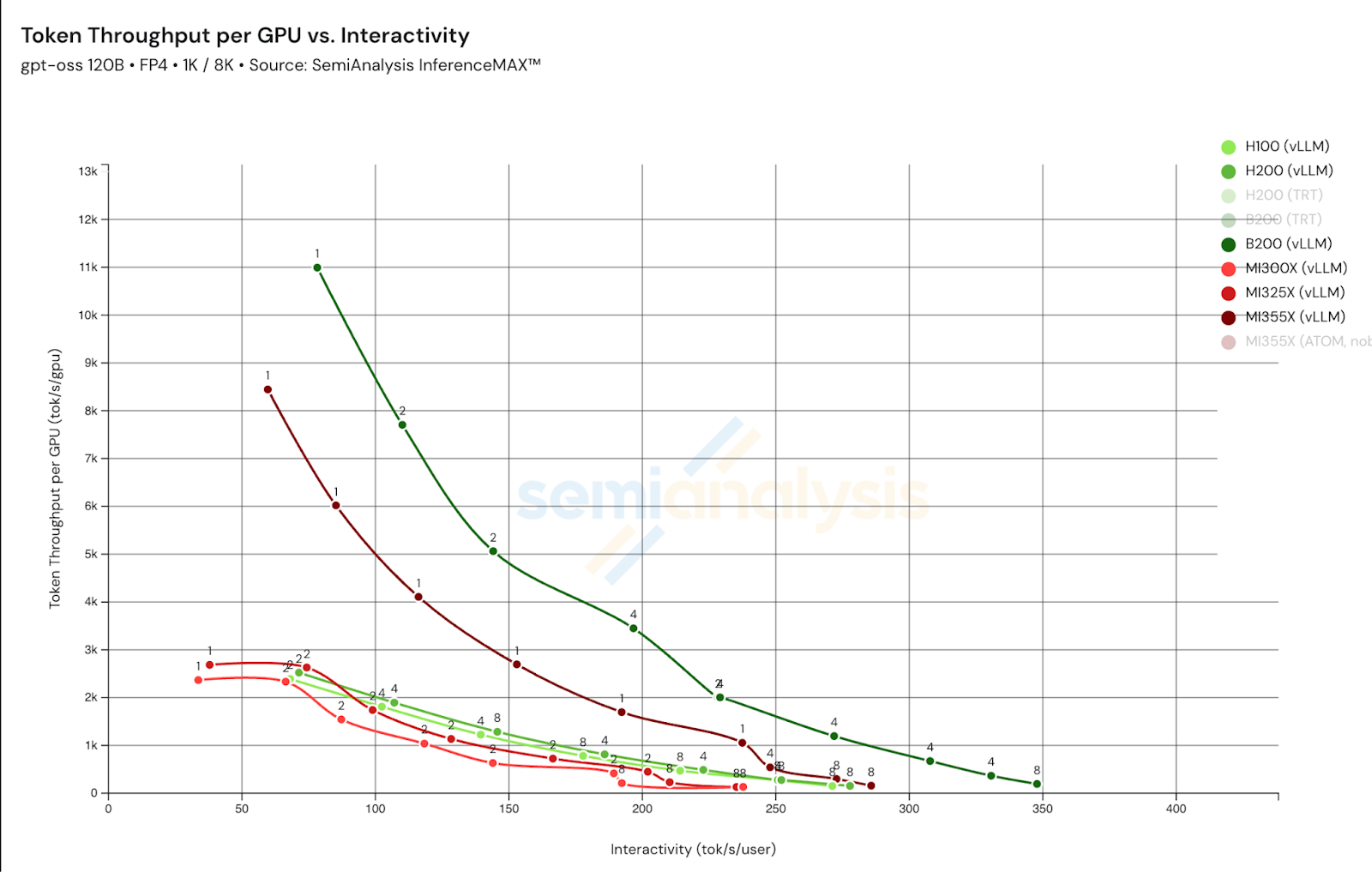
Specialized chips make inference economics in production if they support high throughput on a multi-user basis, not peak tokens/second. This per user is an overlooked metric in the inference market.
With more users, as batching efficiency collapses and memory pressure increases (KV cache reuse), token/sec/user drops off. In these scenarios, requests become more memory than compute bound, so the inference specialized architectures matter.
One camp, like Cerebras and Groq, bets on maximized steady state throughput but struggles with burst and per-request variability. A second camp, like Etched and Tranium, enables preemption, dynamic batching, and better KV-cache isolation as user count increases, allowing throughput to degrade gracefully under mixed workloads. A third camp, TPUs, prioritize predictable memory access, high effective HBM utilization, and reduced cache fragmentation to stabilize performance with more users.
Meanwhile, Intel is quietly sitting on tens of thousands of unsold Gaudi accelerators. A healthy reminder that the market doesn’t just want any chip, but just shit-tons of the best ones.
The winners are those who can preserve throughput with many users and contexts, ultimately determining marginal cost per token at scale.
Re WATTS
Time-to-quality-power (TTQP) is the ultimate driver for new builds, and more multi-billion-dollar infrastructure deals will be won or lost on TTQP alone.
One proxy for incoming power demand is based on the NVIDIA/AMD market bookends for chip production. The implied nameplate power based on this is 25 to 35GW by 2030. But we are now bottlenecked by power; it is not clear where this capacity will get built.
Similarly, we’re seeing a shift in data center TCO; energy is now the smallest but most strategic input. At roughly 5% of TCO, offtake is willing to pay even double for power since a chip online today is worth 2-4x a chip online in 12 months.
As power needs to be managed strategically, battery energy storage systems (BESS) have graduated from just secondary backup tools. BESS smooths aggressive frontier training loads where power sources are less reliable and brittle, helping scale energy capacity faster. New data centers are becoming large integrators of BESS also helping the grid with more distributed capacity and storage.
The winners in power delivery will be modular across generation types, and deliver smooth energy the fastest at the lowest cost.
The Bottom Line
New ideas and industries take time for markets to digest. But the high stakes nature of the AI buildout has brought up sophisticated systems more quickly than in any other technological infrastructure buildout in our history.
Taking the lens of “radically streamline the bottleneck”, the durable advantages of these systems will have:
Marginal cost The ability to reduce marginal cost per token through cheaper power generation, alternative equipment, & dynamic load delivery.
Balance sheet discipline, creditworthiness, and flexible capital structures that compound on leverage.
The ability to diligence, qualify and control powered land quickly.
Mechanisms for rapidly designing and constructing modular, cost efficient AI factories that can absorb exponential increases in power density without retrofitting.
An ability to aggregate more chip types and energy generation surfaces in a modular way.
The ability to curtail loads on massive clusters to get energized quickly and use battery storage to reduce peak load and smooth ramp rates.
Managing and orchestrating supply chains and vendors with software effectively at scale across domestic and foreign supplies, tariffs, production types and lead times.
The winners in 2026 will be the ones who can smartly navigate and open bottlenecks before others. The others will just be wishing there was a Get Out of Jail Free card.
…………………. …………………. …………………. …………………. …………………. …………………. …………………. ………….
Thanks to Anissa Gardizy, Neha Desaraju, Dylan Rose, Granola AI and others.